Artificial intelligence (AI) is changing how people work, learn, shop, and communicate. AI governance is the way of use of AI in a way that aligns with laws, ethics, and business objectives. Businesses use AI to automate tasks, analyze data, and improve customer experiences. Governments use AI to support public services. Schools, hospitals, and financial institutions are also adopting AI technologies.
As AI becomes more powerful, organizations must ensure it is used safely and ethically. This is where AI governance becomes important.
AI governance refers to the rules, processes, policies, and controls that guide how AI systems are developed, deployed, and monitored. It helps organizations reduce risks, maintain trust, and ensure that AI operates responsibly.
In this guide, you will learn what AI governance is, why it matters, its key principles, challenges, frameworks, and future trends.
What Is AI Governance?
AI governance is the system of oversight used to manage artificial intelligence throughout its lifecycle.
It includes the policies, standards, and decision-making processes that ensure AI systems are safe, fair, transparent, and accountable.
The goal of AI governance is not to stop innovation. Instead, it helps organizations use AI in a way that aligns with laws, ethics, and business objectives.
A strong governance program helps organizations:
- Reduce AI-related risks
- Improve transparency
- Ensure legal compliance
- Protect customer data
- Build public trust
- Promote ethical AI use
As AI technologies continue to evolve, governance becomes a critical part of every AI strategy.
Why AI Governance Is Important
AI systems can influence major decisions. They may affect hiring, lending, healthcare, education, and public safety.
Without proper oversight, AI can create serious problems.
Preventing Bias and Discrimination
AI systems learn from data. If the data contains bias, the AI model may produce unfair outcomes.
For example, an AI hiring system may favor certain groups over others if it was trained on biased historical data.
AI governance helps organizations identify and reduce bias through testing, monitoring, and validation.
Protecting Privacy
Many AI systems process personal information.
Strong governance ensures organizations follow data privacy, data protection, and cybersecurity standards.
This helps prevent misuse of sensitive information.
Building Trust
People are more likely to use AI systems when they understand how they work and believe they are fair.
Good governance improves AI transparency and strengthens trust among customers, employees, and regulators.
Supporting Regulatory Compliance
Governments around the world are introducing new AI laws.
Organizations need governance programs to meet AI compliance requirements and avoid legal penalties.
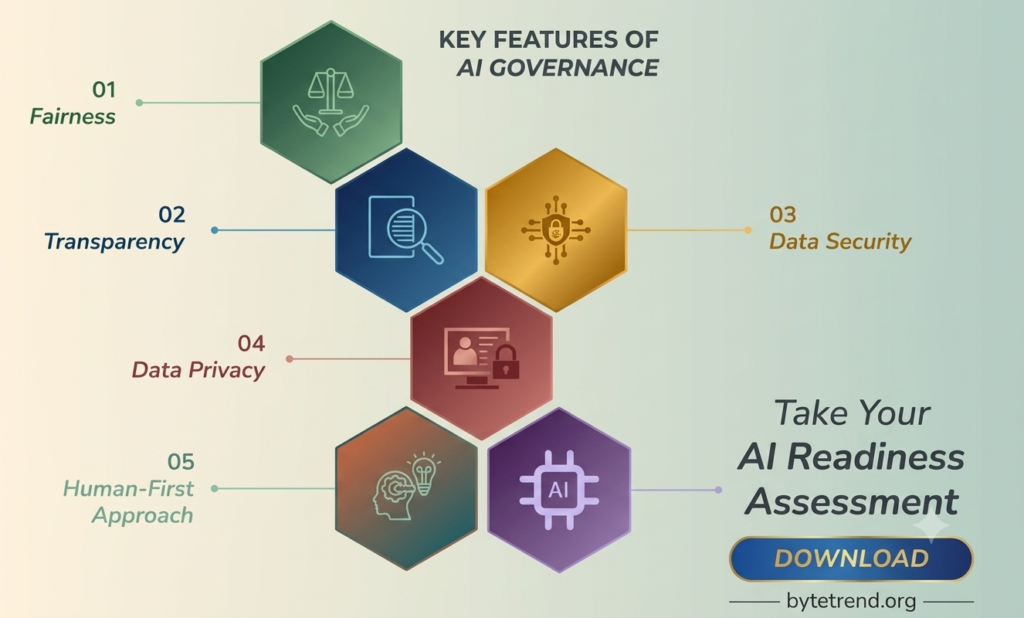
Core Principles of AI Governance
Effective AI governance is built on several important principles.
Fairness
AI systems should treat people fairly.
Organizations should regularly evaluate models to identify bias and prevent discrimination.
Fairness helps ensure equal opportunities and outcomes.
Transparency
Users should understand when AI is being used.
Organizations should explain how AI systems make decisions whenever possible.
Transparent AI creates confidence and accountability.
Accountability
Someone must be responsible for AI decisions.
Organizations should define clear roles and responsibilities for AI oversight.
This ensures that issues can be identified and addressed quickly.
Privacy and Security
AI systems often rely on large amounts of data.
Protecting that data is essential.
Strong governance includes data security, privacy controls, and secure development practices.
Reliability
AI systems should perform consistently and accurately.
Organizations must test AI models before deployment and monitor them afterward.
Reliable AI reduces operational risks.
Human Oversight
Humans should remain involved in important decisions.
Human review helps prevent errors and ensures AI outcomes align with ethical standards.
This concept is often called human-in-the-loop AI.
Key Components of an AI Governance Framework
A successful governance program includes several important elements.
AI Policies
Organizations should create written policies that define how AI can be developed and used.
These policies establish expectations for employees and stakeholders.
Risk Management
Every AI system carries some level of risk.
Organizations should assess risks before deployment and continue monitoring them over time.
Common risks include:
- Bias
- Privacy violations
- Security threats
- Regulatory non-compliance
- Inaccurate outputs
Model Monitoring
AI models can change over time as data patterns evolve.
This issue is known as model drift.
Continuous monitoring helps organizations detect performance problems early.
Documentation
Organizations should maintain detailed records about AI systems.
Documentation often includes:
- Data sources
- Model design
- Testing results
- Risk assessments
- Decision-making processes
Good documentation supports transparency and audits.
Audit and Review
Regular audits help ensure AI systems remain compliant and effective.
Internal and external reviews can identify weaknesses and recommend improvements.
The Relationship Between AI Governance and Responsible AI
The terms AI governance and Responsible AI are closely connected.
However, they are not exactly the same.
Responsible AI focuses on ethical principles such as fairness, transparency, privacy, and accountability.
AI governance provides the structure and processes needed to enforce those principles.
In simple terms:
- Responsible AI defines what organizations should do.
- AI governance defines how they will do it.
Together, they help create trustworthy AI systems.
AI Compliance and Regulatory Requirements
Governments and regulatory bodies are increasing their focus on AI oversight.
Organizations must understand and follow relevant laws.
Understanding AI Compliance
AI compliance refers to meeting legal, regulatory, and organizational requirements related to AI systems.
Compliance efforts may include:
- Risk assessments
- Data protection measures
- Transparency requirements
- Security controls
- Documentation standards
Strong compliance programs reduce legal and reputational risks.
Growing Importance of AI Regulations
Many countries are developing AI regulations to address emerging risks.
These regulations aim to:
- Protect consumers
- Prevent discrimination
- Improve transparency
- Enhance accountability
- Promote safe AI development
Businesses that prepare early will be better positioned to adapt to future requirements.
Industry-Specific Compliance
Different industries face different compliance expectations.
For example:
Healthcare
Healthcare AI must protect patient privacy and support safe medical decisions.
Finance
Financial institutions must ensure AI systems do not create unfair lending or investment outcomes.
Human Resources
AI hiring tools must avoid discriminatory practices and maintain fairness.
Common Challenges in AI Governance
Although governance is essential, implementing it can be difficult.
Rapid Technological Change
AI technology evolves quickly.
Governance programs must adapt to new tools, capabilities, and risks.
Lack of Transparency
Some advanced AI models operate as “black boxes.”
Their decision-making processes can be difficult to explain.
This creates challenges for transparency and accountability.
Data Quality Issues
Poor-quality data can lead to inaccurate results.
Organizations must ensure data is accurate, relevant, and representative.
Managing Multiple Regulations
Companies operating globally may need to comply with multiple laws and standards.
Keeping up with changing regulations can be complex.
Limited Expertise
Many organizations lack professionals with expertise in AI ethics, governance, and compliance.
Building multidisciplinary teams is often necessary.
Best Practices for Effective AI Governance
Organizations can strengthen their governance programs by following proven best practices.
Establish Clear Leadership
Assign responsibility for AI oversight.
Leaders should coordinate governance efforts across departments.
Create Ethical AI Guidelines
Develop clear principles for responsible AI development and use.
These guidelines should align with organizational values.
Conduct Risk Assessments
Evaluate potential risks before deploying AI systems.
Assessments should continue throughout the AI lifecycle.
Maintain Human Oversight
Keep humans involved in high-impact decisions.
Human review can reduce errors and improve accountability.
Monitor AI Performance
Track performance metrics regularly.
Continuous monitoring helps identify problems before they become serious.
Train Employees
Employees should understand AI risks, policies, and compliance requirements.
Training supports a strong governance culture.
Improve Documentation
Maintain detailed records of AI development and decision-making processes.
Documentation simplifies audits and regulatory reviews.
AI Governance Frameworks and Standards
Several organizations have developed frameworks to support responsible AI practices.
These frameworks provide guidance for organizations implementing governance programs.
Common focus areas include:
- Risk management
- Ethical principles
- Transparency
- Accountability
- Security
- Compliance
Many organizations combine multiple frameworks to create governance programs that fit their specific needs.
A well-designed framework helps ensure consistency across AI projects.
The Future of AI Governance
AI governance will continue to evolve as technology advances.
Several trends are shaping the future.
Stronger Regulations
Governments are expected to introduce more comprehensive AI regulations.
Organizations will need stronger compliance programs to meet new requirements.
Increased Transparency
Stakeholders will demand greater visibility into how AI systems make decisions.
Explainable AI techniques will become more important.
Automated Governance Tools
Organizations are increasingly using tools that automate monitoring, reporting, and compliance activities.
These tools can improve efficiency and reduce risk.
Global Standards
International collaboration may lead to more consistent governance standards across countries.
This could simplify compliance for global businesses.
Greater Focus on Ethics
Ethical considerations will become a central part of AI development.
Organizations that prioritize ethics and responsibility will likely earn greater trust from customers and regulators.
Benefits of Strong AI Governance
Organizations that invest in AI governance can achieve many advantages.
These benefits include:
- Improved trust and credibility
- Better risk management
- Enhanced regulatory compliance
- Stronger data protection
- More reliable AI systems
- Reduced operational disruptions
- Better decision-making
- Greater customer confidence
Governance helps organizations maximize AI benefits while minimizing potential harms.
End of Discussion
AI governance has become a critical part of modern AI adoption. As artificial intelligence continues to influence business operations and everyday life, organizations need clear rules and oversight mechanisms.
A strong governance framework promotes Responsible AI, supports AI compliance, and helps organizations meet evolving AI regulations. It also improves transparency, accountability, fairness, and security.
The future of AI depends not only on technological innovation but also on responsible management. Organizations that prioritize governance today will be better prepared to build trustworthy, ethical, and sustainable AI systems tomorrow.