Artificial intelligence is changing the way people work, learn, and solve problems. Over the last few years, AI tools have become more powerful and useful. Today, a new type of AI is gaining attention. It is called agentic ai.
Unlike traditional AI systems that only respond to commands, agentic AI can plan, make decisions, and take actions to achieve goals. This makes it one of the most exciting developments in modern technology.
Businesses, developers, and organizations are exploring how agentic AI can improve productivity, reduce manual work, and create smarter systems. From customer support to software development, agentic AI is opening new possibilities.
In this guide, we will explain what agentic AI is, how it works, its benefits, challenges, real-world applications, and why it is becoming an important part of the future of AI.
What Is Agentic AI?
Agentic AI refers to AI systems that can act independently to achieve a goal. Instead of waiting for step-by-step instructions, these systems can analyze situations, make plans, and perform tasks on their own.
Traditional AI usually follows direct commands. For example, if you ask a chatbot a question, it provides an answer. The interaction ends there.
Agentic AI goes further. It can:
- Understand objectives
- Create plans
- Execute tasks
- Monitor progress
- Adjust actions when needed
This ability makes agentic AI more flexible and useful in complex situations.
Simple Example
Imagine you want to plan a business trip.
A traditional AI assistant may provide flight options when asked.
An agentic AI system could:
- Search for flights
- Compare prices
- Book tickets
- Reserve a hotel
- Add events to your calendar
- Send reminders
All of these actions can happen with minimal human involvement.
How Agentic AI Works
Agentic AI combines several AI technologies to function effectively.
Goal Understanding
The first step is understanding the user’s goal.
For example:
“Create a marketing campaign for a new product.”
The AI identifies the objective and breaks it into smaller tasks.
Planning
The system creates a strategy to achieve the goal.
This planning process may include:
- Research
- Content creation
- Audience analysis
- Campaign scheduling
Execution
After planning, the AI performs actions.
It may interact with software tools, databases, websites, or business systems.
Evaluation
The AI reviews results and determines whether the goal has been achieved.
If necessary, it makes adjustments and tries alternative approaches.
This continuous cycle is one reason agentic AI is considered highly intelligent.
Key Characteristics of Agentic AI
Several features make agentic AI different from traditional AI systems.
Autonomy
The most important feature is autonomy.
Autonomous AI agents can perform tasks without requiring constant human supervision.
Goal-Oriented Behavior
Agentic AI focuses on achieving outcomes rather than simply answering questions.
Adaptability
These systems can respond to changing conditions.
If one method fails, they can explore alternative solutions.
Multi-Step Reasoning
Agentic AI can handle complex tasks involving multiple steps.
This is important for business processes and large-scale projects.
Decision-Making
Agentic systems evaluate information and make informed decisions based on available data.
Agentic AI vs Traditional AI
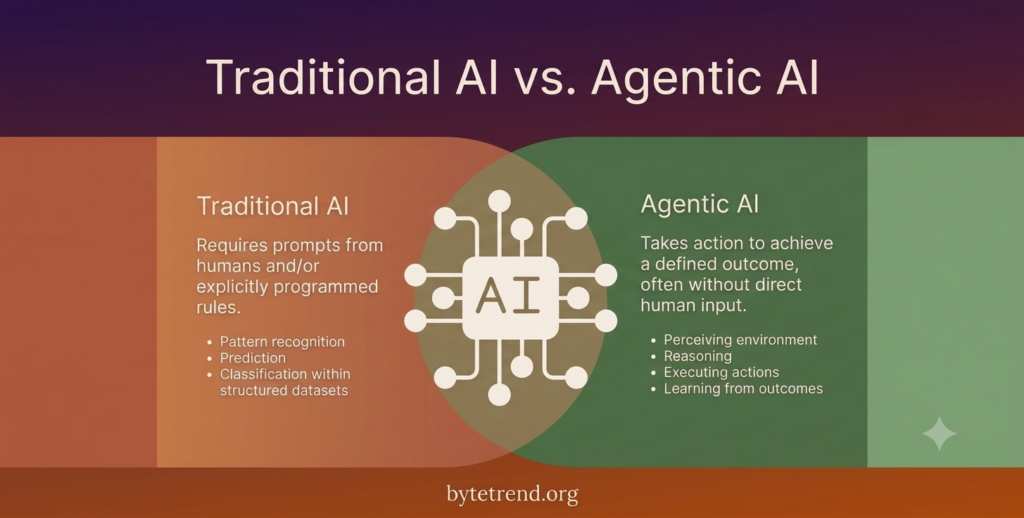
Understanding the difference between these technologies helps explain why agentic AI is gaining popularity.
| Traditional AI | Agentic AI |
| Responds to commands | Pursues goals |
| Limited actions | Performs multiple actions |
| Requires frequent guidance | Works independently |
| Single-task focus | Multi-step task execution |
| Reactive behavior | Proactive behavior |
Traditional AI is useful for answering questions.
Agentic AI is useful for completing objectives.
The Role of Autonomous AI Agents
Autonomous AI agents are the building blocks of agentic AI systems.
These agents can:
- Gather information
- Analyze data
- Make decisions
- Execute tasks
- Learn from outcomes
Each agent may specialize in a specific function.
For example:
- Research agent
- Writing agent
- Customer service agent
- Analytics agent
Multiple agents can work together to solve larger problems.
This approach increases efficiency and scalability.
Agentic AI and AI Workflows
Modern businesses rely heavily on AI workflows to manage operations.
An AI workflow is a sequence of automated steps designed to complete a task.
Agentic AI improves these workflows by adding intelligence and adaptability.
Traditional Workflow Example
A traditional workflow might:
- Receive customer data
- Store information
- Generate reports
The process follows fixed rules.
Agentic Workflow Example
An agentic workflow might:
- Analyze customer behavior
- Identify opportunities
- Recommend actions
- Launch campaigns
- Monitor results
- Adjust strategy automatically
This makes workflows smarter and more effective.
The Connection Between Agentic AI and AI Automation
Many organizations already use AI automation tools.
These tools help automate repetitive tasks.
Examples include:
- Email sorting
- Data entry
- Appointment scheduling
Agentic AI takes automation to a higher level.
Instead of simply following predefined rules, it can:
- Make decisions
- Solve problems
- Adapt to new situations
- Improve performance over time
This creates more advanced forms of automation.
Benefits of Agentic AI
There are many reasons why businesses are investing in agentic AI.
Increased Productivity
Agentic AI can perform tasks faster than humans.
This reduces workload and improves efficiency.
Better Decision-Making
By analyzing large amounts of information, agentic systems can provide valuable insights.
Reduced Costs
Automation reduces the need for manual labor in repetitive processes.
Scalability
Agentic AI can handle growing workloads without significantly increasing operational costs.
Faster Problem Solving
These systems can identify issues and take corrective actions quickly.
Continuous Operation
Unlike humans, AI systems can work 24 hours a day.
This improves service availability and responsiveness.
Real-World Applications of Agentic AI
Agentic AI is already being used across many industries.
Customer Support
AI agents can:
- Answer questions
- Resolve issues
- Process requests
- Escalate complex cases
This improves customer experiences.
Healthcare
Healthcare organizations use AI for:
- Patient monitoring
- Medical research
- Appointment management
- Data analysis
Agentic AI can help medical teams make informed decisions.
Finance
Financial institutions use AI for:
- Fraud detection
- Risk assessment
- Investment analysis
- Customer service
These applications improve accuracy and efficiency.
Software Development
Developers are using agentic AI to:
- Generate code
- Test applications
- Detect bugs
- Improve software quality
This speeds up development cycles.
Marketing
Marketing teams use agentic AI for:
- Content creation
- Audience targeting
- Campaign optimization
- Performance tracking
The technology helps improve return on investment.
Supply Chain Management
Agentic systems can:
- Monitor inventory
- Predict demand
- Optimize shipping routes
- Reduce operational delays
This creates more efficient supply chains.
Technologies Behind Agentic AI
Several technologies support the development of agentic AI.
Large Language Models
Large Language Models (LLMs) provide communication and reasoning capabilities.
They help AI understand instructions and generate responses.
Machine Learning
Machine Learning enables systems to learn from data and improve performance.
Natural Language Processing
Natural Language Processing (NLP) allows AI to understand human language.
Reinforcement Learning
Reinforcement Learning helps AI improve decision-making through experience.
Knowledge Graphs
Knowledge Graphs help organize information and improve reasoning capabilities.
Together, these technologies create intelligent and capable AI agents.
Challenges of Agentic AI
Despite its advantages, agentic AI also faces challenges.
Accuracy Issues
AI systems may sometimes make incorrect decisions.
Careful monitoring is important.
Security Risks
Autonomous systems require strong security measures.
Unauthorized access could create problems.
Ethical Concerns
Organizations must ensure AI behaves responsibly and fairly.
Transparency
Users often want to understand how decisions are made.
Improving explainability remains a key challenge.
Regulatory Compliance
Companies must follow regulations when using AI systems.
This is especially important in industries such as healthcare and finance.
Best Practices for Implementing Agentic AI
Organizations should follow several best practices.
Define Clear Goals
The AI should have specific objectives.
Clear goals improve performance and outcomes.
Maintain Human Oversight
Humans should review important decisions.
This reduces risks and improves reliability.
Focus on Data Quality
High-quality data leads to better results.
Poor data can produce inaccurate outcomes.
Test Thoroughly
Organizations should evaluate AI systems before deployment.
Testing helps identify weaknesses.
Monitor Performance
Continuous monitoring ensures the system operates effectively.
Regular updates help maintain accuracy.
The Future of Agentic AI
The future of agentic AI looks promising.
Experts expect AI agents to become more intelligent and capable.
Future systems may:
- Handle more complex tasks
- Collaborate with humans more effectively
- Manage entire business processes
- Improve decision-making across industries
As technology advances, agentic AI will likely become a standard part of digital operations.
Businesses that adopt these systems early may gain significant competitive advantages.
Conclusion
Agentic AI represents a major step forward in artificial intelligence. Unlike traditional systems, it can plan, reason, act, and adapt to achieve goals.
Through the use of autonomous AI agents, advanced AI workflows, and intelligent AI automation, organizations can improve productivity, reduce costs, and make better decisions.
Although challenges such as security, ethics, and transparency remain, the potential benefits are enormous. As technology continues to evolve, agentic AI is expected to transform industries and reshape the way people interact with intelligent systems.
For businesses and individuals alike, understanding agentic AI today is an important step toward preparing for the future of intelligent automation.